
Get involved
We are a loose network and believe that resistance best comes from the grassroots. We also think that the most effective resistance to immigration raids can take place locally, as we usually don’t know in advance where raids will take place.
We’re not looking to “bring people in” to us, to become another mass organisation. Instead we’d like to see lots of autonomous groups forming and feeling empowered and confident to take action themselves. We aim to provide materials, advice and information to support this.


Set up your local group
Anyone can start an anti-raids group, and every group is different. Here are three things you can do to get your group set up.
Step 1: Build your group
First thing you need for an anti-raids group is people to organise with. One option is to put out an open call-out and organise a public meeting. In Haringey Anti-Raids’ case, this took the form of an open “Raids Resistance Training” – something that was also used to gauge interest in a local anti-raids group. Most established anti-raids groups will help you facilitate a training event.
Another strategy is to organise (initially, at least) via a pre-existing affinity group (e.g. a group of your friends or neighbours or an existing political or social group). This certainly short-cuts some of the initial challenges of forming a group, but can make it harder to grow beyond your initial core.
Step 2: Find out what’s happening locally
One of the first steps is to find out what immigration enforcement is happening in your area. It’s important to get a picture where raids are happening, and who is being targeted. Some strategies we’ve found useful are talking to shopkeepers, placing FOI requests, monitoring online reports of immigration raids (e.g. @AntiRaids on twitter).
Step 3: Figure out what you want to do
Strategies for resisting raids vary dramatically depending on groups. Some groups focus on physically resisting immigration raids, others on spreading information to ensure that people targeted by immigration raids are able to assert their legal rights. Diversity of tactics is good and no-one should feel that wanting to take a less (or more) militant approach makes them wrong.
The key things to consider when discussing approaches are capacities of members of the group as well as the sustainability of any action. If your group stops one raid through direct action and then has to suspend all other activity to spend the next year doing legal support, that might not necessarily be the most effective approach. Sometimes small-scale, replicable, sustainable activity can be more effective than dramatic direct action.
Actions you can take
Raids can be made unworkable through combined efforts and different tactics. Here are some possible initiatives and ideas based around different interests or skillsets which we would love to see people taking on and developing.

Setting up a street stall is useful to build awareness of immigration raids, to provide information about legal rights and to link up with people who may be willing to help challenge them.
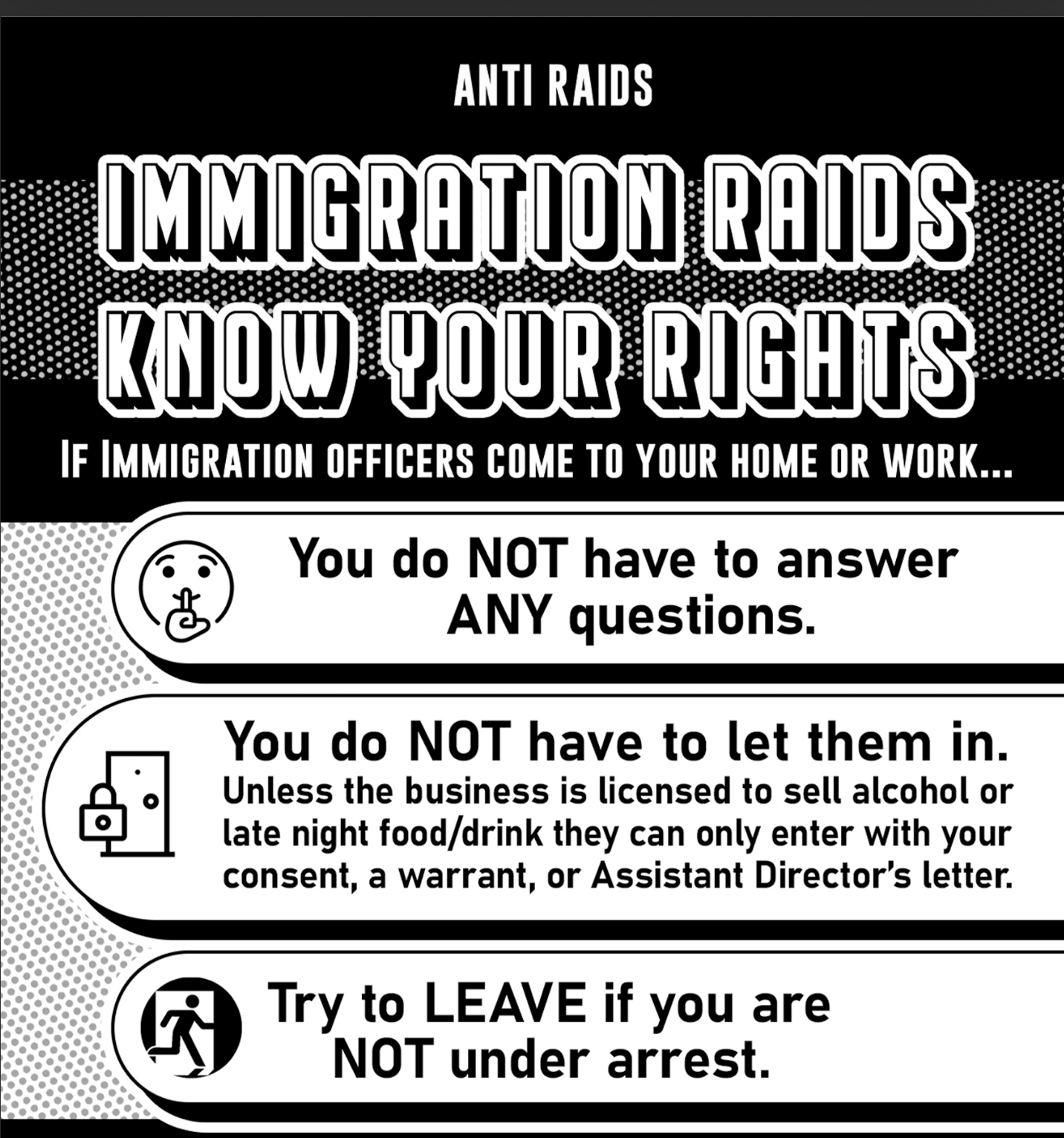
Workshops can be a good way to share your knowledge of how to resist raids and to build relationships with local community groups.

Things you can do if you see an immigration van or a raid in progress.